Aaron: Harold Cohen's Generative Art Programme
From 1973, Harold Cohen at the University of California San Diego developed Aaron, a rule-based programme that autonomously generated original drawings by encoding explicit conditions for artistic decision-making, making it one of the earliest sustained AI systems for creative production.
Background
By the early 1970s, AI researchers had built systems that could solve logical puzzles, play chess, and prove theorems. What almost nobody had tried was pointing those same methods at art. The dominant view, inside and outside computer science, was that creative work was fundamentally different. A matter of feeling and intuition that could not be written down as rules.
That assumption had a practical edge to it. If you could not define what made a drawing good, you could not tell a computer when to stop. Most attempts to get machines to produce images were essentially random processes: vary the parameters, see what comes out. The results were unpredictable, and not in an interesting way. There was no underlying model of what a drawing was actually doing.
Harold Cohen was in an unusual position. He was already an established painter who had represented Britain at the Venice Biennale before he moved into AI research, first at Stanford’s Artificial Intelligence Laboratory and later at the University of California San Diego. He came to the problem as someone who had spent years thinking about the decisions that go into mark-making, not aesthetics in the abstract, but the concrete choices a draughtsman makes: where to put a line, when a region is enclosed enough, how figures relate to a ground.
What happened
Cohen began building Aaron at UCSD as an attempt to encode those decisions explicitly. The programme worked by specifying conditions: rules that governed when a mark could be made, how shapes could be bounded, what counted as a complete region. It was not generating images by searching randomly or by copying examples. Instead, it followed a structured decision process, the way a person following a strict but intricate set of learned habits might draw.
Aaron was first presented publicly at the International Joint Conference on Artificial Intelligence in 1973, where Cohen described the project in a paper on modelling creative behaviour. The images it produced at that stage were abstract, organised mark-making that resolved into coherent compositions without depicting anything recognisable. What made them unusual was that each output was different, and none of them required Cohen to intervene once the programme was running.
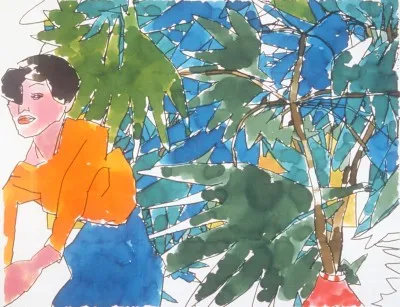
The physical output came through plotters, machines that moved a pen across paper under the programme’s instruction. Cohen built or adapted the hardware so Aaron’s decisions translated into actual drawn lines rather than screen displays. Over the following decades he continued to revise the rules, and the programme’s imagery grew more figurative over time, eventually producing images of people and plants. The Computer History Museum records this as a collaboration that continued for forty years. That sustained development is itself unusual: most AI demonstrations from the 1970s ran briefly and stopped. Aaron kept running, and kept changing, giving Cohen and others a long record of what a rule-based generative system could and could not do across time.
Why it mattered
Aaron demonstrated that symbolic AI could encode aesthetic judgement well enough to produce coherent, original visual work without human intervention at the point of creation, extending rule-based reasoning into a domain previously considered exclusively human. The programme ran continuously for decades, providing an unusually long empirical record of a generative AI system's evolution. It opened sustained debate about whether rule-governed creativity constitutes genuine artistic agency.
People
Organisations
University of California, San Diego, Stanford University
Sources
- On the Modelling of Creative Behaviour. ACM Digital Library (IJCAI 1973 Proceedings). Primary source
- Harold Cohen and AARON: A 40-Year Collaboration. Computer History Museum. institutional
- Aaron: Art from the Machine. Wired. Secondary
Cite this page
AI Achievements. (1973). Aaron: Harold Cohen's Generative Art Programme. Retrieved 2026-10-01, from https://achievements.ai/milestone/aaron-program-by-harold
@misc{achievements_aaron_program_by_harold,
  title  = {Aaron: Harold Cohen's Generative Art Programme},
  author = {{AI Achievements}},
  year   = {1973},
  url    = {https://achievements.ai/milestone/aaron-program-by-harold}
}