Stanford Racing Team's Stanley Wins DARPA Grand Challenge 2005
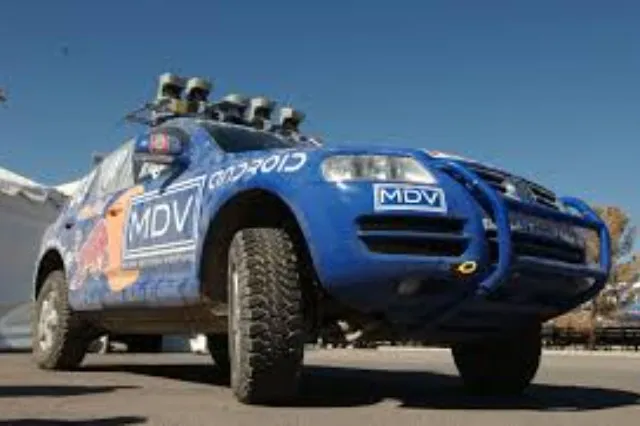
On 8 October 2005, a Stanford University team led by Sebastian Thrun entered Stanley, a modified Volkswagen Touareg, in the DARPA Grand Challenge. Stanley completed the 131.6-mile (211.8 km) Mojave Desert course autonomously in under 7 hours, finishing first and winning the $2 million prize.
Background
For most of the twentieth century, getting a vehicle to drive itself was treated as a problem just around the corner. It kept not being around the corner. The core difficulty was that roads, and especially off-road terrain, do not follow rules in any way a computer could simply be given. A rock might look like a shadow. A shadow might look like a ditch. At highway speed, a bad classification kills someone.
DARPA, the US Defence Department’s research agency, decided in 2004 to force progress by making it a competition. Teams would build autonomous vehicles and race them across 142 miles of Mojave Desert. The prize was $1 million. Every single entrant failed. The furthest any vehicle got was about 7.4 miles before it got stuck or had to be stopped. The problem, it seemed, might simply be too hard.
DARPA ran the challenge again in 2005, this time over a 131.6-mile course, and doubled the prize to $2 million. The field that showed up had spent a year thinking harder.
What happened
Sebastian Thrun, a professor at Stanford University who had previously directed Carnegie Mellon’s robot learning laboratory, led the Stanford Racing Team’s entry into the 2005 race. The vehicle was a modified Volkswagen Touareg named Stanley, built with support from Volkswagen of America. The team included Michael Montemerlo, Hendrik Dahlkamp, David Stavens and more than a dozen other researchers and engineers.
Stanley’s sensor setup combined LIDAR (a system that fires laser pulses and times their return to build a three-dimensional map of the surroundings), radar, and cameras. The key to making that sensor data useful was how the team processed it. Rather than writing out explicit rules for every situation, they used probabilistic machine learning, a method where the system maintains a range of possible interpretations and updates them as new evidence arrives. Gaussian processes, a statistical technique for modelling uncertainty across continuous space, helped Stanley learn from its own driving experience during test runs in the Mojave before the race, building up a picture of which terrain features were actually passable. The sensors fed into this learned model in real time, letting the vehicle make decisions under uncertainty rather than freezing when the world did not match a predetermined template.
On 8 October 2005, Stanley completed the course in 6 hours and 53 minutes. It finished first. Four other teams also finished within the time limit, which was itself a dramatic change from 2004, but Stanley’s time was the fastest. The team collected the $2 million prize. The vehicle had driven 131.6 miles of desert track without a human hand on any control.
Why it mattered
Stanley's victory demonstrated that a robotic ground vehicle could navigate an extended, unstructured off-road route without any human intervention, a capability that had eluded all entrants in the 2004 Grand Challenge. The algorithms developed for Stanley (combining probabilistic machine-learning methods with sensor fusion from LIDAR, radar, and cameras) directly informed the research programmes that later produced Google's self-driving car project and a wider autonomous-vehicle industry. The DARPA Grand Challenge series as a whole catalysed academic and commercial investment in autonomous-vehicle research by proving the problem was tractable.
People
Sebastian Thrun, Michael Montemerlo, Hendrik Dahlkamp, David Stavens, Andrei Aron, James Diebel, Douglas Fong, John Gale, Morgan Halpenny, Gabriel Hoffmann, Bret Kimoto, Lilia Marmor, Reto Nieto, Kevin A Peterson, Adam Platinsky, Joel Vitus, Wim Burgard
Organisations
Stanford University, Stanford Racing Team, DARPA, Volkswagen of America
Sources
- Stanford's Stanley wins DARPA Grand Challenge. Stanford University News Service. Official
- Stanley: The Robot that Won the DARPA Grand Challenge. Journal of Field Robotics, Wiley. Primary source
- DARPA Grand Challenge. Defense Advanced Research Projects Agency. Official
Cite this page
AI Achievements. (2005). Stanford Racing Team's Stanley Wins DARPA Grand Challenge 2005. Retrieved 2026-10-01, from https://achievements.ai/milestone/first-autonomous-vehicle-by-stanford
@misc{achievements_first_autonomous_vehicle_by_stanford,
  title  = {Stanford Racing Team's Stanley Wins DARPA Grand Challenge 2005},
  author = {{AI Achievements}},
  year   = {2005},
  url    = {https://achievements.ai/milestone/first-autonomous-vehicle-by-stanford}
}