Blue Brain Project Digital Reconstruction of the Rat Somatosensory Cortex Microcircuitry
On 8 October 2015, Henry Markram and colleagues at the Blue Brain Project published a detailed computational reconstruction of 31,000 neurons and 37 million synapses in a 0.29 mm³ column of juvenile rat somatosensory cortex, creating the first large-scale digital model of a mammalian cortical microcircuit.
Background
Neuroscientists had spent decades mapping the brain at two very different scales. At one end, electrophysiology experiments could record the electrical behaviour of individual neurons with great precision. At the other, brain imaging could show activity across whole regions. What sat between those two scales, the fine-grained wiring of a small patch of cortex and how its collective activity emerged from that wiring, was largely out of reach.
The problem was partly practical. A cubic millimetre of cortex contains tens of thousands of neurons, each forming hundreds or thousands of connections with its neighbours. No experiment can monitor all of them at once, let alone manipulate them independently. Researchers could build simplified models by hand, but those models required assumptions about which biological details actually mattered. Without a systematic reconstruction, there was no principled way to test those assumptions.
By the early 2010s, the Blue Brain Project at the École Polytechnique Fédérale de Lausanne (EPFL) had spent years assembling the raw ingredients: standardised protocols for recording the electrical properties of individual neuron types, anatomical data on how those types were distributed across cortical layers, and statistical rules describing how neurons of different types connect to one another. The question was whether that data, taken together, was enough to build something that actually behaved like real tissue.
What happened
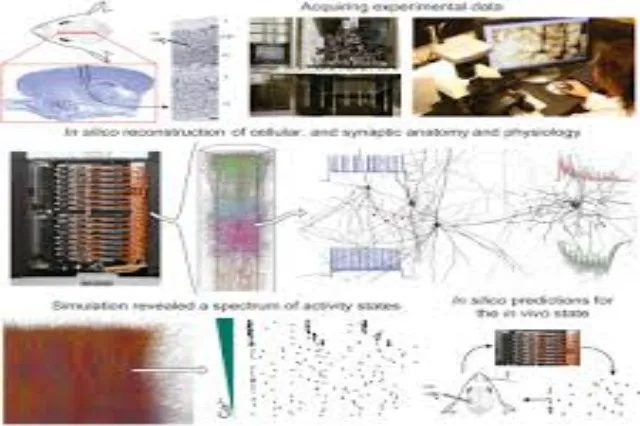
On 8 October 2015, Henry Markram, Eilif Muller, Michael Reimann, Srikanth Ramaswamy, Csaba Eröe, James King, Felix Schürmann and their colleagues at the Blue Brain Project published the results in the journal Cell. They had built a computational reconstruction of a 0.29 mm³ column of somatosensory cortex, the region of a juvenile rat’s brain that processes touch, containing 31,000 neurons and 37 million synapses. Each neuron was modelled with its own recorded electrical properties. The connections between them were placed according to the anatomical and statistical constraints the team had accumulated, rather than tuned by hand to produce a desired output.
The reconstruction ran on the Blue Brain IV supercomputer at EPFL, using the NEURON simulation environment, software designed to model the electrical dynamics of individual nerve cells at a level of biological detail that most large-scale models skip entirely. The team then ran simulations and compared the results against published recordings from real rat cortex, both from living animals and from tissue kept alive in laboratory dishes. The model reproduced a range of those observed patterns without being fitted to them directly, which was the key test: the reconstruction was constrained by biology, not by the target behaviour.
The collaboration involved the Human Brain Project alongside the Blue Brain Project, and the team released the model and its underlying data through the Neocortical Microcircuit Collaboration Portal, making it available for other researchers to use and interrogate. That openness mattered, because the value of a model like this comes partly from what others can do with it: running experiments that would be impossible or unethical in living tissue, or testing whether a proposed mechanism can actually produce the activity it is supposed to explain.
Why it mattered
The reconstruction allowed in silico experiments on cortical dynamics that would be impossible to conduct simultaneously in living tissue, providing a platform for testing hypotheses about emergent network behaviour at cellular resolution. It demonstrated that biologically constrained simulation could reproduce a range of in vivo and in vitro electrophysiological observations, validating the approach as a complement to experimental neuroscience. The project also set a methodological template for subsequent large-scale brain modelling efforts under the Human Brain Project and elsewhere.
People
Henry Markram, Eilif Muller, Michael Reimann, Srikanth Ramaswamy, Csaba Eroe, James King, Felix Sch Rmann
Organisations
Blue Brain Project, Cole Polytechnique F D Rale de Lausanne Epfl, Human Brain Project
Sources
- Reconstruction and Simulation of Neocortical Microcircuitry. Cell. Primary source
- Reconstruction and Simulation of Neocortical Microcircuitry (PubMed Central full text). PubMed Central / National Library of Medicine. institutional
- Neocortical Microcircuit Collaboration Portal, Blue Brain Project. École Polytechnique Fédérale de Lausanne (EPFL). Official
Cite this page
AI Achievements. (2015). Blue Brain Project Digital Reconstruction of the Rat Somatosensory Cortex Microcircuitry. Retrieved 2026-10-01, from https://achievements.ai/milestone/first-digital-reconstruction-project
@misc{achievements_first_digital_reconstruction_project,
  title  = {Blue Brain Project Digital Reconstruction of the Rat Somatosensory Cortex Microcircuitry},
  author = {{AI Achievements}},
  year   = {2015},
  url    = {https://achievements.ai/milestone/first-digital-reconstruction-project}
}