Hawk-Eye Ball-Tracking System Developed by Paul Hawkins at Roke Manor Research
In 2001, Paul Hawkins, working at Roke Manor Research in Hampshire, developed Hawk-Eye, a computer-vision system that triangulates footage from multiple broadcast cameras to reconstruct the three-dimensional trajectory of a sports ball in near real time, first used in cricket television coverage.
Background
Tracking a moving ball on television had been done, after a fashion, for years before 2001. Graphics teams could draw a line over recorded footage to show roughly where a ball had gone. But that line was an illustration, not a measurement. It was produced by hand, frame by frame, and it told you nothing precise about height, speed, or the exact point of impact.
The harder problem was ball-path reconstruction in three dimensions. A single camera captures a flat image, so there is no depth information. You can see where the ball appears on screen, but not how far away it was from the lens at any given moment. Broadcasters and umpires had no reliable way to answer questions like whether a delivery in cricket would have gone on to hit the stumps, because the ball had already been interrupted by the batsman’s pad. The decision came down to the umpire’s instinct, and that was often contested.
Sports governing bodies were aware of the problem. Officiating disputes in cricket in particular had become a recurring source of frustration, at both broadcast and elite competitive level. What was needed was a system that could take the flat images from multiple cameras simultaneously and work backwards to produce a single, accurate three-dimensional picture of where the ball had actually been, and where it was heading.
What happened
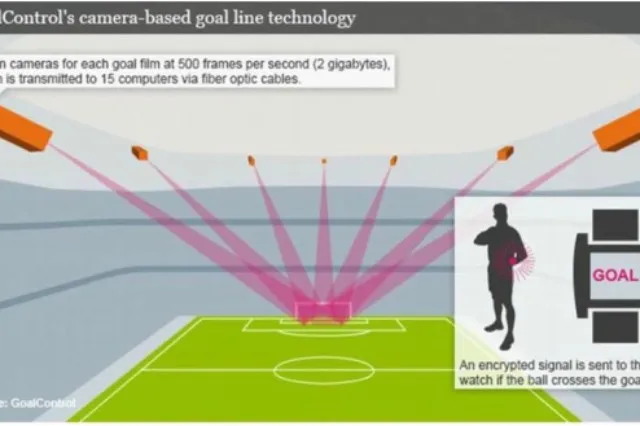
Paul Hawkins, an engineer at Roke Manor Research in Hampshire, built a system that did exactly that. Several broadcast cameras, positioned at different angles and heights around the ground, each captured the ball in flight. Because each camera saw the ball from a slightly different position, the system could compare those views and calculate the ball’s position in three-dimensional space at each moment. String those positions together and you have a trajectory: not drawn by hand, but derived from the footage itself.
The method is described in UK patent GB2379821A, filed by Hawkins and Roke Manor Research and published in 2003, which sets out the apparatus and mathematics behind the approach. The system built a model of the playing surface and the ball’s physical behaviour, so it could also project the path forward beyond the point where the ball was stopped or left the frame. That forward projection is what made it useful for cricket’s lbw (leg before wicket) question, where an umpire must judge whether a delivery would have hit the stumps if the batsman’s pad had not been in the way.
The system was first used in 2001 for television coverage of cricket, producing the animated ball-path graphics that became familiar to broadcast audiences. At that stage it was a production tool, giving viewers a clearer picture of what had happened, rather than an official input to match decisions. The path from broadcast aid to formal officiating use came later. Hawkins went on to found Hawk-Eye Innovations to develop and licence the technology commercially, and Roke Manor Research retained an involvement in the underlying work.
Why it mattered
Hawk-Eye introduced camera-based probabilistic trajectory reconstruction to professional sport, giving broadcasters and later match officials a reliable tool for adjudicating contested ball-tracking decisions. Its deployment in cricket's Decision Review System from 2009 onwards established computer vision as a legitimate arbiter in elite sport, a model subsequently adopted in tennis, football, and snooker. The system demonstrated that real-time multi-camera triangulation could achieve accuracy sufficient for high-stakes officiating, accelerating investment in sports-analytics infrastructure worldwide.
People
Paul Hawkins
Organisations
Roke, Hawk Eye Innovations
Sources
- The Observer profile: Hawk-Eye. The Guardian / The Observer. Secondary
- GB2379821A – Apparatus and method for tracking the trajectory of a moving object (Hawk-Eye patent filed by Paul Hawkins and Roke Manor Research). UK Intellectual Property Office via Google Patents. Primary source
- Hawk-Eye: The Technology Behind the Decision Review System. Science Museum Group. institutional
Cite this page
AI Achievements. (2001). Hawk-Eye Ball-Tracking System Developed by Paul Hawkins at Roke Manor Research. Retrieved 2026-10-01, from https://achievements.ai/milestone/hawk-eye-computer-system-by-paul-hawkins
@misc{achievements_hawk_eye_computer_system_by_paul_hawkins,
  title  = {Hawk-Eye Ball-Tracking System Developed by Paul Hawkins at Roke Manor Research},
  author = {{AI Achievements}},
  year   = {2001},
  url    = {https://achievements.ai/milestone/hawk-eye-computer-system-by-paul-hawkins}
}