Movidius (Intel) Launches Neural Compute Stick
In July 2017, Movidius, an Intel subsidiary, released the Movidius Neural Compute Stick, a USB-form-factor device housing the Myriad 2 Vision Processing Unit, enabling developers to run inference from trained deep neural networks on low-power edge hardware without a remote server.
Background
Training a neural network and running one are very different problems. By the mid-2010s, researchers and developers had got reasonably good at the training side, using large clusters of GPUs to teach a model to recognise objects, faces or gestures. The harder problem was what happened next. Once you had a trained model, running it, a process called inference, still generally meant sending data to a server. A camera on a factory floor, a drone, a prototype robot: any of these would have to phone home to get an answer.
The alternative was to run inference locally, on the device itself. The obstacle was power and size. A GPU capable of running a modern convolutional network, one that scans an image in small overlapping patches to find features, drew far more power than a battery-powered device could supply. Embedded processors could handle simple tasks but not the matrix arithmetic that deep networks depend on. The gap between “trained in a data centre” and “working in the real world” was, for many developers, essentially unbridgeable without custom silicon. And custom silicon was expensive to design and order in the volumes that made it affordable.
Movidius, a semiconductor company based in Dublin that Intel had acquired in 2016, had been working on a chip called the Myriad 2 Vision Processing Unit, a VPU, which is a processor designed specifically for the kind of computation that vision tasks require. The chip was already appearing in products such as the DJI Phantom 4 drone, but using it required hardware integration that most software developers could not easily manage.
What happened
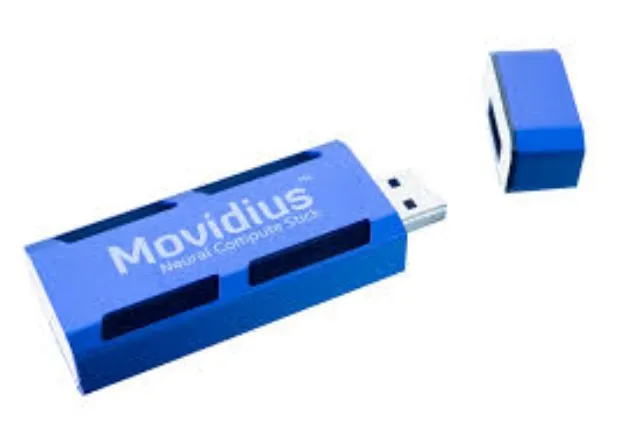
In July 2017, Intel launched the Movidius Neural Compute Stick. It was a small device in a USB form factor, meaning it was roughly the size and shape of a USB memory stick, and it plugged into a standard USB 3.0 port. Inside it was a Myriad 2 VPU. A developer could take a neural network they had already trained on a desktop machine using frameworks such as Caffe or TensorFlow, compile it for the Myriad 2 using a software toolkit Movidius provided, and then run inference on the stick itself.
The device was priced at under $100. It drew its power from the USB port and required no fan. A laptop or a Raspberry Pi (a cheap, credit-card-sized computer popular with hobbyists and researchers) could become a host. Intel positioned it explicitly at developers and researchers who wanted to build and test computer-vision applications without access to a GPU server. Supported network types at launch included convolutional networks for image classification and object detection.
What the stick did not do was train networks. That step still needed a more powerful machine. The stick handled only the inference end, taking a frozen, compiled model and running it against new inputs. Within that constraint it was a practical piece of hardware: quiet, cheap, and requiring no specialist knowledge to connect. For anyone trying to show that a vision model could work on a low-power device before committing to a full embedded design, it cut out a considerable amount of engineering work.
Why it mattered
The Neural Compute Stick was among the earliest commercial products to place a dedicated neural-network inference accelerator in a device small enough to plug directly into a laptop or embedded board, lowering the barrier to deploying computer-vision models outside data-centre environments. By targeting the USB interface and a sub-$100 price point, it opened edge AI prototyping to developers and researchers who lacked access to GPU clusters. The Myriad 2 VPU architecture it introduced became the basis for subsequent generations of Intel edge-inference silicon, influencing how the industry approached on-device AI acceleration.
Organisations
Sources
- Intel Democratizes Deep Learning Application Development with Launch of Movidius Neural Compute Stick. Intel Newsroom. Primary source
- Intel Movidius Neural Compute Stick Launched. AnandTech. Secondary
Cite this page
AI Achievements. (2017). Movidius (Intel) Launches Neural Compute Stick. Retrieved 2026-10-01, from https://achievements.ai/milestone/intel-movidious-neural-compute-stick-ncs
@misc{achievements_intel_movidious_neural_compute_stick_ncs,
  title  = {Movidius (Intel) Launches Neural Compute Stick},
  author = {{AI Achievements}},
  year   = {2017},
  url    = {https://achievements.ai/milestone/intel-movidious-neural-compute-stick-ncs}
}