UMass Amherst researchers demonstrate protein-nanowire memristors for neuromorphic computing
In June 2021, researchers at the University of Massachusetts Amherst published findings in Nature Communications showing that protein nanowires harvested from the bacterium Geobacter sulfurreducens can function as memristors, enabling brain-inspired computation at ultralow power without a conventional battery.
Background
Most AI hardware runs on silicon chips that separate memory from processing. Data has to travel back and forth between the two, and that journey consumes energy. For tasks that mimic the brain, such as recognising patterns or learning from experience, this back-and-forth becomes a serious bottleneck. Neuromorphic computing tries to solve the problem by building devices where memory and computation happen in the same place, the way a biological synapse does.
A memristor is a component that can do this. It is a resistor whose electrical resistance changes depending on the current that has passed through it, and that change persists after the power is off. That makes it behave a little like a synapse that strengthens or weakens depending on use. Silicon and metal-oxide memristors had been explored for years, but they required conventional fabrication methods, high temperatures, and still drew more power than biological neural tissue by many orders of magnitude.
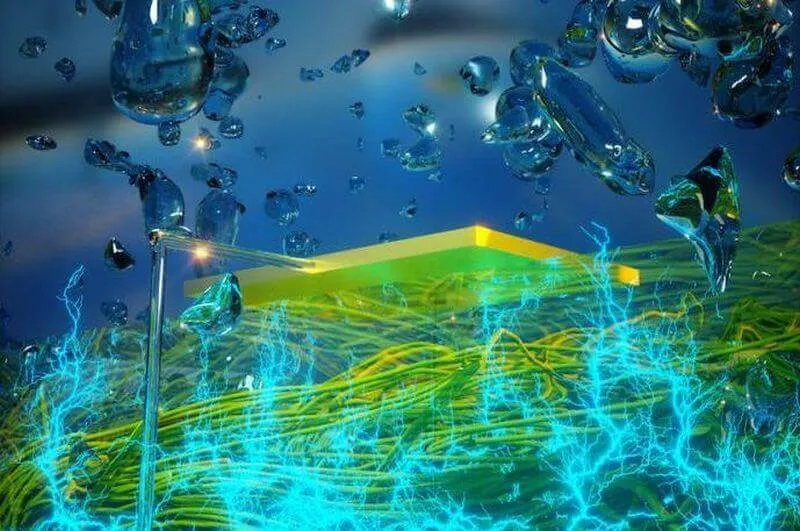
Meanwhile, Jun Yao and Derek Lovley at the University of Massachusetts Amherst had already shown, in work published in Nature Nanotechnology in February 2020, that protein nanowires harvested from the bacterium Geobacter sulfurreducens could generate electricity from humidity in the air. Those nanowires are hair-thin filaments, about 1.5 nanometres in diameter, that the bacterium grows naturally to transfer electrons. The question that remained was whether the same material could be made to compute, not just to generate current.
What happened
On 17 June 2021, Yao, Lovley and their colleagues published a paper in Nature Communications showing that protein nanowires from Geobacter sulfurreducens can act as memristors. They placed the nanowires between two electrodes and showed that the device switched between high-resistance and low-resistance states in response to electrical signals, the basic requirement for memristive behaviour. Because resistance in the device depends on how much current has previously flowed through it, it can hold information without power being applied continuously.
The devices operated at voltages below 0.5 volts and consumed power in the range of a few nanowatts, far below what conventional neuromorphic hardware requires. The team demonstrated that the memristors could be connected to perform simple synaptic functions, including a process called spike-timing-dependent plasticity, which is the mechanism thought to underlie learning in biological neural networks. All of this happened at room temperature, with no battery required to maintain the stored state.
What makes the material unusual is that it is grown, not manufactured. Geobacter produces the nanowires as part of its ordinary biology, and the wires can be harvested in bulk. The devices are also biocompatible, meaning they do not rely on toxic metals or high-temperature processing steps. At the time of publication this remained a laboratory demonstration; the team had not yet built a working neuromorphic processor around the material. But the results were concrete: a biological, self-assembling material behaving as a trainable synaptic device at power levels that silicon-based alternatives have not reached.
Why it mattered
Protein nanowire memristors offer a biological, self-assembling alternative to silicon-based neuromorphic hardware, potentially reducing the energy cost of in-memory computation by orders of magnitude. Because the material is grown rather than fabricated, it points toward sustainable, biocompatible AI hardware. The work extends the team's earlier demonstration of electricity-harvesting 'Air-Gen' protein nanowires into the domain of trainable synaptic devices.
People
Organisations
University of Massachusetts Amherst
Sources
- Memristors based on microbial protein nanowires enable energy-efficient neuromorphic computation. Nature Communications. Primary source
- UMass Amherst Researchers Develop Living Materials-Based Memristors for Neuromorphic Computing. University of Massachusetts Amherst. Official
- Power generation from ambient humidity using protein nanowires. Nature Nanotechnology. Primary source
Cite this page
AI Achievements. (2021). UMass Amherst researchers demonstrate protein-nanowire memristors for neuromorphic computing. Retrieved 2026-10-01, from https://achievements.ai/milestone/mit-researchers-have-created-a-self-sustainable-microsystem
@misc{achievements_mit_researchers_have_created_a_self_sustainable_microsystem,
  title  = {UMass Amherst researchers demonstrate protein-nanowire memristors for neuromorphic computing},
  author = {{AI Achievements}},
  year   = {2021},
  url    = {https://achievements.ai/milestone/mit-researchers-have-created-a-self-sustainable-microsystem}
}