Cornell University researchers demonstrate electrically actuated microscale origami robots with onboard CMOS control
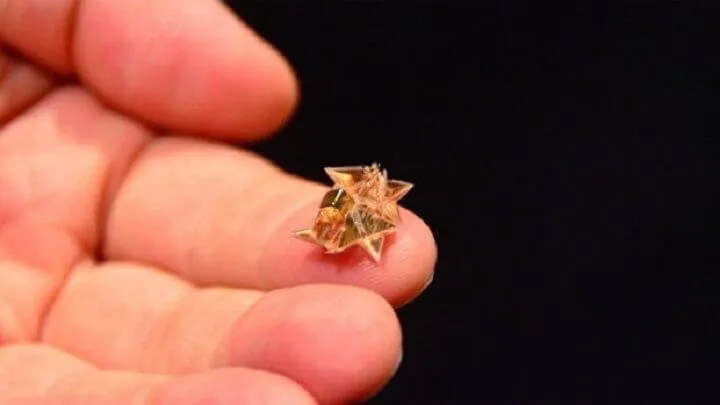
On 17 March 2021, researchers at Cornell University published a demonstration of self-folding microscale robots, roughly 100–250 microns in size, driven by platinum-based shape-memory actuators and controlled by onboard complementary metal-oxide-semiconductor (CMOS) circuits, enabling untethered, electrically commanded origami-style locomotion at the micron scale.
Background
Building robots small enough to move through the human body had been a goal in engineering for decades. By the 2010s, researchers could fabricate structures at the micron scale, roughly the width of a human hair, but making those structures move in any controlled way was another matter. Most microscale devices relied on external triggers: a magnetic field applied from outside the body, a laser, or a chemical gradient. None of those approaches gave the robot any ability to act on its own.
The deeper problem was putting a brain on something that small. Conventional robotics solves control with a circuit board and a microcontroller, but at the scale of a hundred microns or so, there is simply no room for components built that way. Researchers could make a thing that moved or a thing that could process instructions. Getting both onto the same body, at the same scale, had not been done.
Actuation was its own challenge. Shape-memory alloys, which bend when heated and return to their original shape when cooled, work reasonably well at larger scales, but the platinum bilayer approach, where thin films of platinum respond to an electrochemical signal to fold or unfold a hinge, turned out to be far better suited to fabrication at the micron scale. The manufacturing question and the physics question were tangled together.
What happened
On 17 March 2021, a team led by Itai Cohen and Paul McEuen at Cornell University, working with Marc Miskin who had by then moved to the University of Pennsylvania, published a paper in Science Robotics describing robots between about 100 and 250 microns long that could walk under electrical command, with no external tether and no optical or magnetic trigger. The robots were made in batches on standard silicon wafers, using the same semiconductor fabrication processes that produce computer chips, and a single four-inch wafer could hold around a million of them.
Each robot carried onboard complementary metal-oxide-semiconductor (CMOS) circuits, the same transistor technology used in everyday electronics, shrunk down and bonded directly to the robot body. Those circuits received electrical signals and told the platinum-based actuators, thin hinges that bend when a small voltage is applied, when to fold and when to open. The result was origami-style locomotion: the robot moved by folding and unfolding its limbs in sequence, driven entirely by the onboard logic responding to an electrical input.
The fabrication route drew on atomic layer deposition, a technique that builds up extremely thin and uniform films one atomic layer at a time, to produce the platinum hinges with enough precision to function reliably at that scale. Combining that with standard CMOS processing was the key step the group had been working toward. Prior results from the same team had shown the folding mechanism could work, but integrating programmable electronic control directly onto the same device, at this size, was what the 2021 paper established.
Why it mattered
Integrating programmable CMOS logic directly onto a sub-millimetre robot body had not previously been achieved at this scale, allowing the device to respond to electrical signals without external mechanical or optical triggers. This opened a path toward autonomous microrobots capable of navigating confined biological environments such as blood vessels or tissue, where neither tethered control nor bulky onboard power had previously been feasible. The work established a fabrication route that combines semiconductor processing with mechanical actuation, bridging microelectronics and robotics at a scale relevant to medical and materials applications.
People
Itai Cohen Cornell University, Paul Mceuen Cornell University, Marc Miskin University of Pennsylvania, Formerly Cornell
Organisations
Cornell University, University of Pennsylvania
Sources
- Electronically integrated, mass-manufactured, microscopic robots. Science Robotics. Primary source
- Atomic layer deposition enables microscale robots. Cornell Chronicle (Cornell University). Official
- Electronically integrated, mass-manufactured, microscopic robots (Nature letter). Nature. Primary source
Cite this page
AI Achievements. (2021). Cornell University researchers demonstrate electrically actuated microscale origami robots with onboard CMOS control. Retrieved 2026-10-01, from https://achievements.ai/milestone/nanotech-scientists-create-worlds-smallest-origami-nanorobot
@misc{achievements_nanotech_scientists_create_worlds_smallest_origami_nanorobot,
  title  = {Cornell University researchers demonstrate electrically actuated microscale origami robots with onboard CMOS control},
  author = {{AI Achievements}},
  year   = {2021},
  url    = {https://achievements.ai/milestone/nanotech-scientists-create-worlds-smallest-origami-nanorobot}
}