Nomad Robot Field Experiment, Atacama Desert
In June 1997, Carnegie Mellon University deployed the Nomad robot in the Atacama Desert, Chile, in a NASA-funded field experiment testing long-range autonomous and teleoperated rover navigation over approximately 220 kilometres of terrain, directly informing future planetary exploration rover design.
Background
By the mid-1990s, planetary scientists and roboticists had a shared problem. Sending a rover to another planet was extraordinarily expensive, and no one had good empirical data on how far such a machine could actually travel across rough terrain, or how the division of labour between the robot and a human operator should work in practice. Laboratory tests could only tell you so much. Simulated environments were clean in ways that real ground never is.
Field trials existed, but they were short. A robot might cross a few hundred metres under controlled conditions, which left open the question of how systems would hold up over distances relevant to an actual planetary surface mission. Mechanical components wear. Software faults accumulate. The communication delays between operator and machine, which on Mars would run to minutes in each direction, were rarely replicated honestly.
The Atacama Desert in Chile offered something useful: terrain that was genuinely hostile, sparsely vegetated, and geologically interesting in ways that resembled Mars. Getting there was logistically complicated, but the environment could not be faked elsewhere.
What happened
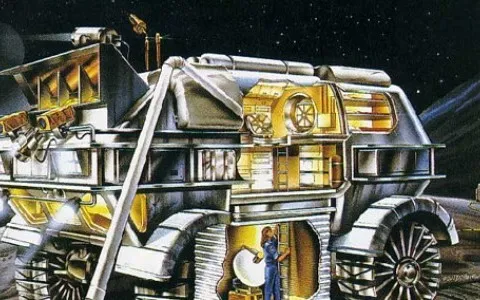
In 1997, a team at the Carnegie Mellon University Robotics Institute led by researchers including David Wettergreen, Illah Nourbakhsh, Reid Simmons, and William Whittaker deployed a robot called Nomad across the Atacama. The project was funded by NASA. Nomad was a large wheeled vehicle with a transforming chassis, meaning its wheelbase could expand for stability on rough ground and contract for transport. The mechanical design was central to the experiment, not incidental to it.
Over the course of the field experiment, Nomad covered approximately 220 kilometres of desert terrain. Some of that travel was autonomous, with the robot making its own navigation decisions based on sensor data. Some was teleoperated, with a human operator directing the machine remotely. The experiment tested both modes deliberately, and one of the things the team was trying to understand was where the boundary between the two should sit: which decisions a robot could reasonably make for itself, and which needed a human in the loop.
The science integration side of the work mattered too. Nomad carried instruments to assess the terrain, and the experiment generated data on how a rover could be directed to conduct real scientific observations rather than simply move from one point to another. That question, how to make a traversal scientifically productive rather than just a demonstration of mobility, was one the planetary science community genuinely needed answered before committing to surface missions. The findings fed directly into thinking about rover design and operations in the years that followed.
Why it mattered
Nomad demonstrated that a wheeled robot could traverse rough, remote terrain over distances relevant to planetary surface missions, providing empirical data on autonomous navigation, science instrument integration, and human–robot interaction at scale. The experiment was one of the most extensive rover field trials conducted before Mars Pathfinder's Sojourner landed in the same year, and its findings shaped subsequent NASA rover engineering and operational concepts. It also established the Atacama Desert as a scientifically valuable analogue environment for Mars, a convention that persists in planetary robotics research.
People
David Wettergreen, Illah Reza Nourbakhsh, Reid Gordon Simmons, William Whittaker
Organisations
Carnegie Mellon University Robotics Institute, Nasa
Sources
- Nomad Rover Field Experiment, Atacama Desert, Chile 1: Science Results Overview. Autonomous Robots (Springer/Kluwer). Primary source
- Nomad: A Demonstration of the Transforming Chassis. Autonomous Robots (Springer/Kluwer). Primary source
- Nomad Robot Project, Carnegie Mellon Robotics Institute. Carnegie Mellon University Robotics Institute. Official
Cite this page
AI Achievements. (1997). Nomad Robot Field Experiment, Atacama Desert. Retrieved 2026-10-01, from https://achievements.ai/milestone/nomad-first-space-rover-for-experiment
@misc{achievements_nomad_first_space_rover_for_experiment,
  title  = {Nomad Robot Field Experiment, Atacama Desert},
  author = {{AI Achievements}},
  year   = {1997},
  url    = {https://achievements.ai/milestone/nomad-first-space-rover-for-experiment}
}