Ernst Dickmanns and VaMoRs Autonomous Van Test, Bundeswehr University Munich
In 1986, Ernst Dickmanns and colleagues at Bundeswehr University Munich demonstrated VaMoRs, a Mercedes-Benz van retrofitted with cameras and real-time computer vision, capable of autonomous driving on traffic-free roads at speeds up to approximately 96 km/h, marking one of the earliest working autonomous vehicle demonstrations.
Background
By the early 1980s, the idea of a self-driving vehicle was not new. Researchers had been thinking about it since at least the 1960s, and several laboratories had built vehicles that could move without a human at the controls. The trouble was how they worked. Most relied on carefully prepared environments: marked tracks, structured floors, or sensors embedded in the road itself. Take away the infrastructure and the vehicle stopped making sense of the world.
Computer vision existed, but applying it to a moving vehicle in real time was a different problem entirely. A camera produces an enormous flood of data every second. The hardware of the early 1980s could process images, but not quickly enough to be useful for driving. More fundamentally, most vision systems at the time treated each image as a separate puzzle. They did not carry any understanding of how the world had looked a moment before, or how it was likely to look a moment later. A vehicle needs exactly that: a continuous, updating picture of where it is and where things around it are going.
The dominant approach to robot control was also quite rigid. Engineers wrote explicit rules: if the road curves left by this much, turn the wheel by that much. It worked in controlled conditions. It broke down whenever reality departed from what the rule-writers had anticipated, which, on a public road, was often.
What happened
Ernst Dickmanns and his team at Bundeswehr University Munich took a different approach. Rather than writing rules to cover every situation, they built a system that maintained a running estimate of the vehicle’s state and updated it continuously as new sensor data arrived. The mathematical engine behind this was an extended Kalman filter, a method for combining uncertain measurements into the best available estimate of a changing situation. Dickmanns called the broader framework the 4D approach: three dimensions of space plus time, treated together rather than as separate problems.
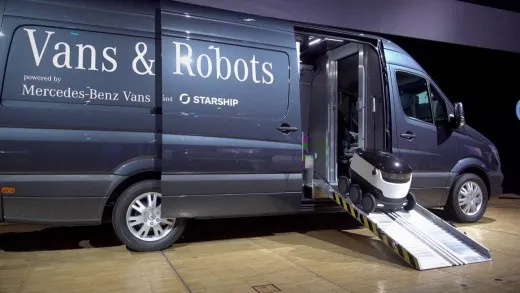
The vehicle they used was VaMoRs, a Mercedes-Benz van fitted with cameras and the computing hardware needed to process the images in real time. The van was not following a track or receiving signals from the road. It was watching the world through its cameras and deciding what to do based on what it saw. In 1986, during tests on traffic-free roads, VaMoRs reached speeds of around 96 km/h under this autonomous control.
What made this credible rather than merely impressive was the architecture underneath it. The 4D approach meant the system was not just reacting to the current image; it was predicting what the next image should look like given the vehicle’s motion, then comparing that prediction to what the camera actually saw. The gap between prediction and reality drove the corrections. This gave the system a kind of short-term memory and made it far more stable than anything purely reactive. Dickmanns described this work in retrospective accounts as establishing that vision-based dynamic reasoning, rather than infrastructure or pre-programmed rules, could be enough to keep a vehicle on a road at highway speed.
Why it mattered
VaMoRs established that real-time recursive estimation, specifically a 4D approach combining spatial and temporal reasoning via extended Kalman filtering, could replace hand-coded rule systems for vehicle control, influencing the design of autonomous vehicle programmes for decades. Dickmanns's work predated and directly informed later DARPA-funded efforts and the broader shift towards vision-based autonomy. It demonstrated that a vehicle could navigate a highway environment using onboard sensing alone, without track-following infrastructure, setting a precedent that shaped both academic and industrial robotics.
People
Organisations
Bundeswehr University Munich, Mercedes-Benz
Sources
- Vehicles Capable of Dynamic Vision: A New Breed of Technical Beings?. IEEE Robotics and Automation Magazine. Primary source
- Machines Perceiving and Thinking: Ernst D. Dickmanns and His Contributions to Dynamic Machine Vision. Artificial Intelligence (Elsevier). Secondary
Cite this page
AI Achievements. (1986). Ernst Dickmanns and VaMoRs Autonomous Van Test, Bundeswehr University Munich. Retrieved 2026-10-01, from https://achievements.ai/milestone/robotic-van-developed-by-mercedes-benz
@misc{achievements_robotic_van_developed_by_mercedes_benz,
  title  = {Ernst Dickmanns and VaMoRs Autonomous Van Test, Bundeswehr University Munich},
  author = {{AI Achievements}},
  year   = {1986},
  url    = {https://achievements.ai/milestone/robotic-van-developed-by-mercedes-benz}
}