Sojourner Rover Lands on Mars as First Autonomous Wheeled Vehicle on Another Planet
On 4 July 1997, NASA's Sojourner rover became the first wheeled vehicle to operate on another planet, driving onto the Martian surface as part of the Mars Pathfinder mission. Sojourner used onboard hazard-avoidance logic and laser stripe sensors to navigate autonomously when out of direct communication with Earth.
Background
By the mid-1990s, space agencies had sent many probes to Mars, but all of them sat still. Landers like Viking 1 and Viking 2 had touched down in 1976 and taken measurements from a fixed point. They could not move to a better rock, avoid a slope, or approach anything that looked interesting. Whatever they could reach with a fixed arm was all they got.
A wheeled robot could do far more, in principle. The problem was control. Radio signals between Earth and Mars take between three and twenty minutes to arrive, depending on where the two planets sit in their orbits. You cannot drive a vehicle by remote control when your steering command takes that long to arrive and your view of the result takes just as long to come back. Any rock in the path, any soft patch of soil, could end the mission before a human operator had time to react.
The answer was to give the robot some ability to make decisions on its own. Not full autonomy, more of a division of labour: people on Earth would plan routes and set goals, and the rover would handle the short-range detail of not destroying itself.
What happened
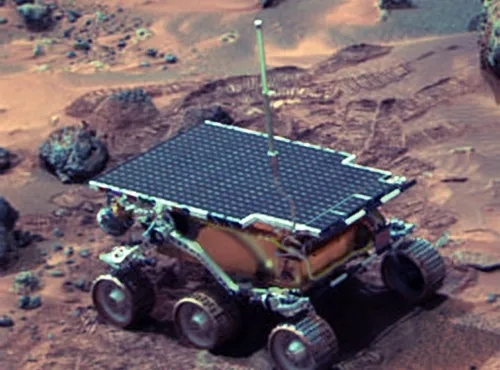
NASA’s Jet Propulsion Laboratory built Sojourner under the Mars Pathfinder programme. Donna Shirley, the programme manager at JPL, led the broader mission, while Jacob Matijević, Sojourner’s chief engineer at JPL, oversaw the rover’s design. The vehicle was small, about the size of a microwave oven, and weighed roughly 10.6 kilograms.
The Pathfinder lander touched down on Mars on 4 July 1997, and Sojourner drove onto the surface the same day. To find its way without waiting for instructions, the rover carried a laser stripe system: a set of lasers that projected lines across the ground ahead, and cameras that read how those lines bent to detect obstacles. If something blocked the path, Sojourner would stop or go around it. Commands from Earth still directed where the rover should go overall, but the hazard response happened on board, in the moment.
Sojourner also carried an APXS, an alpha proton X-ray spectrometer, which it pressed against rocks and soil to measure their chemical composition. The rover operated for 83 sols (a sol is one Martian day, about 24 hours and 37 minutes) before contact was lost, well beyond its planned seven-sol design life. In that time it travelled about 100 metres across the Martian surface and analysed several rocks, some of which the team named informally after their shapes and textures.
The mission did not attempt anything like full autonomy. Sojourner still depended on the Pathfinder lander as a relay station for communicating with Earth, and its onboard decision-making covered a narrow range of situations. But within that range it worked. A robot had driven itself across another planet and come back with results.
Why it mattered
Sojourner demonstrated that a rover could execute short-range autonomous navigation decisions on a planetary surface without waiting for human commands, a round-trip communication delay of up to 20 minutes making real-time teleoperation impractical. Its successful 83-sol operation validated the architecture of semi-autonomous planetary rovers and directly informed the design of subsequent Mars rovers, including Spirit, Opportunity, and Curiosity. The mission established control-systems and onboard hazard detection as essential components of space robotics.
People
Donna Shirley NASA Jpl, Mars Pathfinder Rover Programme Manager, Jacob Matijevic NASA Jpl, Sojourner Rover Chief Engineer
Organisations
NASA Jet Propulsion Laboratory Jpl
Sources
- The Martian Chronicle, Issue 39, Mars Pathfinder Mission Update. NASA Mars Exploration Programme. Official
- Mars Pathfinder Mission Overview. NASA Jet Propulsion Laboratory. Official
- Autonomous Navigation Results from the Mars Pathfinder Microrover. NASA Technical Reports Server. Primary source
Cite this page
AI Achievements. (1997). Sojourner Rover Lands on Mars as First Autonomous Wheeled Vehicle on Another Planet. Retrieved 2026-10-01, from https://achievements.ai/milestone/sojourner-rover-at-nasa-by-judith-resnik
@misc{achievements_sojourner_rover_at_nasa_by_judith_resnik,
  title  = {Sojourner Rover Lands on Mars as First Autonomous Wheeled Vehicle on Another Planet},
  author = {{AI Achievements}},
  year   = {1997},
  url    = {https://achievements.ai/milestone/sojourner-rover-at-nasa-by-judith-resnik}
}