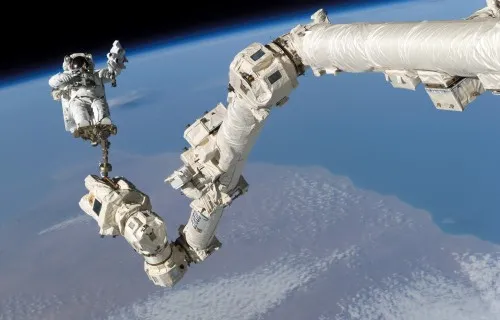
Space Station Remote Manipulator System (Canadarm2) Deployed on the International Space Station
On 22 April 2001, the Space Station Remote Manipulator System (Canadarm2), built by MD Robotics of Canada, was installed on the International Space Station during the STS-100 mission. The 17-metre robotic arm used computer-vision and control-systems software to manoeuvre equipment, modules, and astronauts autonomously or under remote supervision.
Background
Assembling a structure the size of a football pitch in orbit is not a job you can do by hand. Spacewalking astronauts can bolt components together and run cables, but they cannot lift a 14-tonne module unaided, or hold a piece of hardware perfectly still while it is bolted into place. The early International Space Station relied on the shuttle’s own robotic arm, Canadarm, which had been flying since 1981. That arm was useful, but it was attached to the shuttle, not the station. Once the shuttle undocked and flew home, the station had no arm of its own.
That was a real constraint. The station was still being built. New modules needed to be grabbed from shuttle cargo bays and guided into position. Maintenance work required moving heavy equipment from one part of the growing structure to another. Ground controllers and engineers at MD Robotics in Brampton, Ontario, working with the Canadian Space Agency and NASA, spent years designing a system that could do all of that without being carried there and back by a shuttle on every visit.
What happened
On 22 April 2001, spacewalking astronauts from Space Shuttle Endeavour’s STS-100 mission installed Canadarm2 on the station’s Destiny laboratory module. The arm stretches 17 metres when fully extended and can handle payloads of up to 116,000 kilograms in the microgravity environment of low Earth orbit. It has seven motorised joints, which gives it a range of movement a human arm cannot match, and it can operate from either end: a latching mechanism at each tip allows it to anchor itself to the station and then swing its free end around to a new position, effectively walking along the structure.
The control system was where the computing work sat. Canadarm2 used computer-vision software and sensor data to track objects and hold position, working either under supervision from astronauts inside the station or from controllers on the ground at NASA’s Johnson Space Center and the Canadian Space Agency’s facility in Saint-Hubert, Quebec. The arm could also execute pre-programmed sequences with a degree of autonomy, correcting for drift and unexpected loads without waiting for human input on every step. According to the NASA technical report on initial on-orbit operations, the system went through a careful activation and checkout sequence after installation before the station crew formally accepted it.
The Mobile Servicing System, of which Canadarm2 is the centrepiece, also includes a mobile base that travels along rails running the length of the station’s truss. That means the arm is not fixed in one spot. It can reposition itself to reach wherever the work is, which matters on a structure being built over years in stages.
Why it mattered
Canadarm2 demonstrated that a large-scale robotic arm could perform autonomous and semi-autonomous manipulation tasks in the hostile environment of low Earth orbit, including capturing free-flying spacecraft and relocating itself across the station structure. Its sensor-guided control systems set a precedent for AI-assisted robotics in crewed spaceflight operations. The system remains operational and has influenced the design of subsequent space-based manipulators, including the European Robotic Arm.
Organisations
Md Robotics Now Mda Space, Canadian Space Agency, Nasa
Sources
- Mobile Servicing System Overview. NASA. Official
- Canadarm2 and the Mobile Servicing System. Canadian Space Agency. Official
- The Mobile Servicing System: Summary of Initial On-Orbit Operations. NASA Technical Reports Server. Primary source
Cite this page
AI Achievements. (2001). Space Station Remote Manipulator System (Canadarm2) Deployed on the International Space Station. Retrieved 2026-10-01, from https://achievements.ai/milestone/space-station-remote-manipulator-system
@misc{achievements_space_station_remote_manipulator_system,
  title  = {Space Station Remote Manipulator System (Canadarm2) Deployed on the International Space Station},
  author = {{AI Achievements}},
  year   = {2001},
  url    = {https://achievements.ai/milestone/space-station-remote-manipulator-system}
}