Spaun: A Large-Scale Functional Brain Model Capable of Performing Multiple Cognitive Tasks
In November 2012, Chris Eliasmith and colleagues at the University of Waterloo published a description of Spaun (Semantic Pointer Architecture Unified Network) in Science, presenting a 2.5-million-neuron brain model capable of performing eight distinct cognitive tasks, including digit recognition, question answering, and list recall.
Background
By the early 2010s, computational neuroscience had produced many models of the brain, but almost all of them were narrow by design. A model that explained how neurons in the visual cortex respond to edges would not tell you anything about memory or decision-making. A model of working memory would not perform a motor task. Researchers built these focused simulations because the brain is enormously complex, and keeping a model tractable meant keeping it small.
The deeper problem was not just size. Even large simulations tended to model brain activity statistically, showing what firing patterns looked like without the network actually doing anything with the information. The gap between “this model resembles neural data” and “this model behaves like an animal” was wide, and few attempts had seriously tried to close it across more than one or two behaviours at a time.
There was also a practical bottleneck. Simulating millions of neurons interacting in real time required software that most research groups did not have easy access to. Chris Eliasmith and his colleagues at the University of Waterloo’s Centre for Theoretical Neuroscience had spent years developing two tools to address this: the Neural Engineering Framework, a mathematical method for encoding information in populations of spiking neurons, and Nengo, a software platform for building and running those kinds of networks at scale.
What happened
In November 2012, Eliasmith and colleagues including Charles H. Anderson, Trevor Bekolay, James Bergstra, Yan Chen, Travis DeWolf, Naj Nozari, Marc Stewart and Penelope K. Vyas published their description of Spaun in Science. Spaun, which stands for Semantic Pointer Architecture Unified Network, contained about 2.5 million simulated neurons. It received visual input as images of handwritten digits and produced output by controlling a simulated arm that drew responses on a screen.
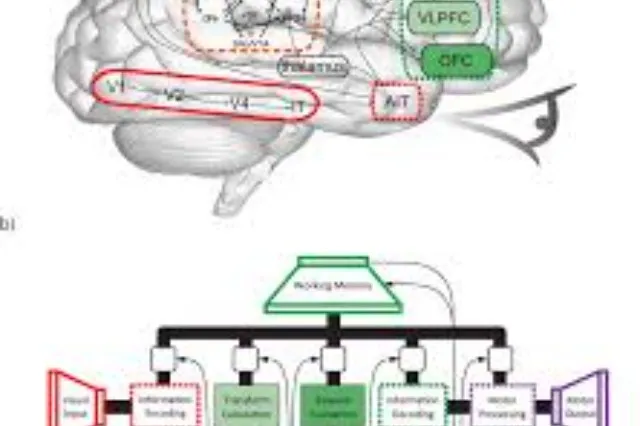
What made Spaun unusual was that a single network, without being reprogrammed between tasks, could do eight different things: copy a drawing, recognise digits, complete a series by analogy, count, answer simple questions, recall a list in order, and perform two further cognitive tasks. The architecture was built around semantic pointers, a way of compressing structured information into patterns of neural activity that can be combined and unpacked again. This let the model pass information between brain regions in a way that loosely mirrors how neuroscientists think biological signals are routed.
The team tested Spaun’s behaviour against human data. On a serial working memory task, where a person hears a list and then tries to recall it, Spaun reproduced the characteristic human pattern: items at the beginning and end of the list are remembered more reliably than those in the middle. It also showed a gradual drop in performance on tasks as the model aged, something the researchers produced by simulating neuron loss over time. The paper appeared in Science on 30 November 2012, and a Nature News report the following day described it reaching top scores on standard cognitive tests used to assess humans.
Why it mattered
Spaun demonstrated that a single, biologically constrained neural architecture could reproduce a range of human cognitive behaviours without task-specific reprogramming between them, addressing a long-standing gap between narrow neural simulations and the generality of biological cognition. Its use of the Neural Engineering Framework and the Nengo platform offered a replicable methodology for building large-scale functional brain models. The work provided a benchmark against which future neuromorphic and cognitive-architecture research could be measured.
People
Chris Eliasmith, Charles H Anderson, Trevor Bekolay, James Bergstra, Yan Chen, Travis DeWolf, Naj Nozari, Marc Stewart, Penelope K Vyas
Organisations
University of Waterloo, Centre for Theoretical Neuroscience Waterloo
Sources
- A Large-Scale Model of the Functioning Brain. Science (AAAS). Primary source
- Simulated Brain Scores Top Test Marks. Nature News. Secondary
- A Large-Scale Model of the Functioning Brain, Science Vol. 338. Science (AAAS). Official
Cite this page
AI Achievements. (2012). Spaun: A Large-Scale Functional Brain Model Capable of Performing Multiple Cognitive Tasks. Retrieved 2026-10-01, from https://achievements.ai/milestone/spaun-the-first-computer-model
@misc{achievements_spaun_the_first_computer_model,
  title  = {Spaun: A Large-Scale Functional Brain Model Capable of Performing Multiple Cognitive Tasks},
  author = {{AI Achievements}},
  year   = {2012},
  url    = {https://achievements.ai/milestone/spaun-the-first-computer-model}
}