CIMON Launched to the International Space Station
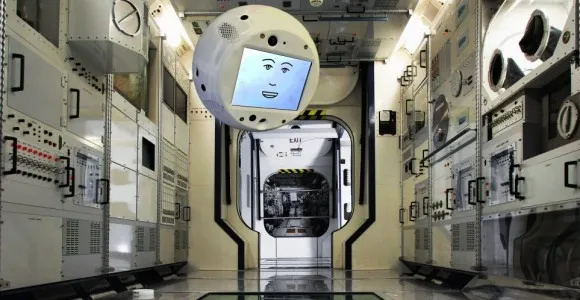
In June 2018, DLR, Airbus, and IBM launched CIMON (Crew Interactive Mobile Companion), a spherical, voice-controlled AI assistant, to the International Space Station aboard SpaceX CRS-15. It was designed to support ESA astronaut Alexander Gerst with procedural tasks and reduce cognitive workload.
Background
By the mid-2010s, voice-controlled AI assistants were common on Earth. Systems built on IBM Watson could answer questions, recognise speech reliably, and hold a short conversation. Computer vision had improved to the point where a camera-equipped device could identify objects in front of it. None of that was new.
What nobody had tested was whether those capabilities held up in a working spacecraft. The International Space Station is a confined, pressurised environment where the air circulates constantly, equipment hums from every direction, and nothing sits still in the usual way. Speech recognition trained on ground conditions might struggle with the acoustic signature of the station. A floating object that needs to orientate itself cannot rely on the feel of gravity to know which way is up. And the people using it are busy, often tired, and doing work where errors carry real consequences.
The practical question was whether an AI assistant could actually help in that setting, or whether the gap between a demo and a working deployment would prove too wide.
What happened
DLR, the German Aerospace Center, led the development of CIMON with Airbus and IBM as co-developers. The result was a spherical, floating unit about the size of a medicine ball, controlled entirely by voice. IBM Watson provided the speech recognition. The device also carried cameras for computer vision, giving it the ability to track faces and identify what it was looking at. A set of internal fans let it move and reorient itself without touching anything, which mattered in a cabin where free-floating objects are a hazard.
CIMON launched to the station in June 2018 aboard SpaceX CRS-15. On board was Alexander Gerst, an ESA astronaut who was serving as crew member during the Horizons mission and who had been involved in testing the system before flight. The intended role was specific: Gerst could ask CIMON to display procedural steps, call up technical documentation, or simply talk through a task. The idea was to reduce the mental load of having to break off from physical work to consult a manual.
The deployment was an experiment as much as an operational tool. DLR and NASA treated it as a test of whether the hardware and software held up in microgravity, whether Watson’s speech recognition could cope with the acoustic environment on the station, and whether a crew member under real working conditions found the system useful rather than distracting. The data gathered fed into both the longer-term CIMON programme and broader research into what embodied AI systems need to function reliably in safety-critical settings.
Why it mattered
CIMON represented an early practical test of conversational AI and autonomous navigation in a microgravity environment, combining IBM Watson speech recognition with computer vision and spatial orientation systems. The project examined whether an AI assistant could meaningfully reduce astronaut stress and error rates during complex procedures, generating data relevant both to human spaceflight and to embodied AI in confined, safety-critical settings. It also marked a rare instance of a commercial AI platform, IBM Watson, being validated in an operational space mission context.
People
Organisations
Airbus, IBM, Dlr German Aerospace Center, Nasa, Esa, SpaceX
Sources
- CIMON, Crew Interactive Mobile Companion. DLR (German Aerospace Center). Primary source
- CIMON (Crew Interactive Mobile Companion), ISS National Lab Experiment Record. NASA. Official
- Meet CIMON, the astronaut's assistant. European Space Agency. Secondary
Cite this page
AI Achievements. (2018). CIMON Launched to the International Space Station. Retrieved 2026-10-01, from https://achievements.ai/milestone/the-first-ai-robot-cimon-sent-you-space
@misc{achievements_the_first_ai_robot_cimon_sent_you_space,
  title  = {CIMON Launched to the International Space Station},
  author = {{AI Achievements}},
  year   = {2018},
  url    = {https://achievements.ai/milestone/the-first-ai-robot-cimon-sent-you-space}
}