IBM TrueNorth: a neuromorphic integrated circuit with one million programmable neurons
In August 2014, researchers at IBM Research published a description of TrueNorth, a neuromorphic chip containing one million programmable spiking neurons and 256 million synapses on a 4096-core CMOS integrated circuit, built under the DARPA SyNAPSE programme.
Background
Most computer chips are built around the same basic idea that John von Neumann described in the 1940s: a processor fetches data from memory, does something with it, and sends results back. That back-and-forth is fast by human standards, but it uses a great deal of power, and the energy cost rises steeply as you scale up. For tasks like recognising a face or identifying a sound, the chip is doing continuous, intensive work regardless of whether anything interesting is happening in the input.
The brain handles this differently. Biological neurons are mostly quiet. They fire electrical pulses only when their inputs cross a threshold, and the rest of the time they draw almost nothing. Researchers had spent decades building mathematical models of this behaviour, particularly a family of models called leaky integrate-and-fire neurons, where each neuron accumulates incoming signals over time and fires when the total passes a certain level, then resets. The models were well understood. What was missing was hardware that could run them at any useful scale. A simulation spread across ordinary processors had to emulate spiking behaviour in software, which meant most of the power savings disappeared before you started.
What happened
Through the DARPA SyNAPSE programme (Systems of Neuromorphic Adaptive Plastic Scalable Electronics), DARPA had been funding work on chips that could implement spiking behaviour directly in silicon rather than simulating it. IBM Research was the primary team developing this hardware, led by Dharmendra S. Modha and including Paul Merolla, John V. Arthur, Rodrigo Alvarez-Icaza, Filipp Akopyan, Jun Sawada and others. Their chip, TrueNorth, was described in a paper published in Science on 8 August 2014.
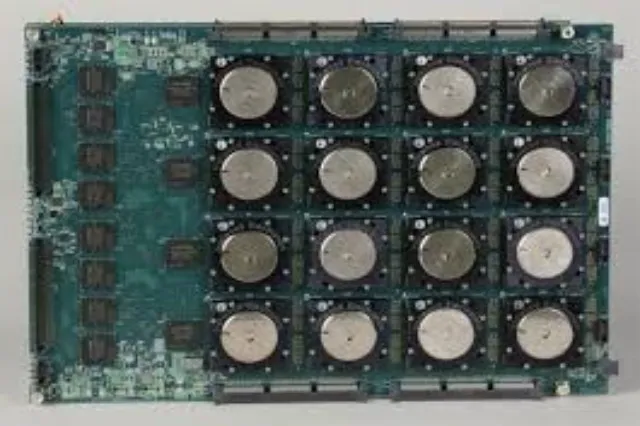
TrueNorth contained 4,096 processor cores on a single CMOS integrated circuit, each core holding 256 neurons. That gave the chip one million programmable spiking neurons in total. Each neuron was connected to 256 synapses, the links across which signals pass between neurons, giving 256 million synaptic connections across the whole chip. Every neuron used the leaky integrate-and-fire model: it accumulated weighted inputs, and when those inputs pushed its internal value past a threshold, it fired a spike and reset. Between spikes it did nothing and consumed almost no power.
The chip was event-driven. Cores only did work when spikes arrived, so power consumption tracked activity rather than running at a fixed rate. IBM reported a power figure of 70 milliwatts for the chip running a pattern-recognition task, a number that sits in a different range from conventional processors handling equivalent workloads. TrueNorth was not designed to train neural networks. It was built for inference, running already-trained models on real-world sensory data. At the time of publication it represented the largest spiking neural network implemented on a single chip, and it gave researchers working on neuromorphic computing a concrete platform to test ideas that had previously lived almost entirely in simulation.
Why it mattered
TrueNorth demonstrated that brain-inspired, event-driven computation could be implemented at scale in silicon, achieving substantially lower power consumption than conventional von Neumann processors for pattern-recognition tasks. The chip provided a concrete hardware substrate for spiking neural network research, which had previously lacked a practical large-scale platform. Its publication established neuromorphic engineering as a viable direction for energy-efficient inference hardware.
People
Merolla Paul, Arthur John V, Alvarez Rodrigo, Akopyan Filipp, Neftci Emre, Kassner Alexander, Sawada Jun, Plank Bradley, Modha Dharmendra S
Organisations
Sources
- A Million Spiking-Neuron Integrated Circuit with a Scalable Communication Network and Interface. Science (AAAS). Primary source
- TrueNorth publication page, IBM Research. IBM Research. Official
- Merolla et al., 'A Million Spiking-Neuron Integrated Circuit', IEEE reprint record. IEEE Xplore. Secondary
Cite this page
AI Achievements. (2014). IBM TrueNorth: a neuromorphic integrated circuit with one million programmable neurons. Retrieved 2026-10-01, from https://achievements.ai/milestone/truenorth-ibm-synapse-system
@misc{achievements_truenorth_ibm_synapse_system,
  title  = {IBM TrueNorth: a neuromorphic integrated circuit with one million programmable neurons},
  author = {{AI Achievements}},
  year   = {2014},
  url    = {https://achievements.ai/milestone/truenorth-ibm-synapse-system}
}