Zoe: Autonomous Astrobiology Field Robot for the Atacama Desert
In 2004, a team from Carnegie Mellon University's Field Robotics Center, NASA Ames Research Center, and the University of Tennessee deployed the Zoe rover autonomously across Chile's Atacama Desert, demonstrating robotic detection of subsurface biological life with relevance to astrobiology and future Mars exploration.
Background
Sending a rover somewhere useful, without someone watching and guiding it every step, had been a problem for decades. The rovers that researchers could build in the 1990s depended heavily on ground operators: a human looked at the terrain, decided where to go, and sent commands. On Mars, that arrangement is painfully slow. Radio signals take several minutes each way, so a rover waiting for instructions wastes most of its day sitting still.
The Atacama Desert in northern Chile had become a testing ground for ideas about autonomous exploration, partly because of the terrain and partly because of the biology. The Atacama is one of the driest places on Earth, and life there is sparse, patchy, and hidden. Micro-organisms survive mostly underground, sheltered from ultraviolet radiation. Finding them required a rover that could make its own decisions about where to look, because the patches are too small and too scattered for a pre-planned route to catch reliably. Nobody had shown that a robot could do that kind of science-directed searching without human guidance in real field conditions.
What happened
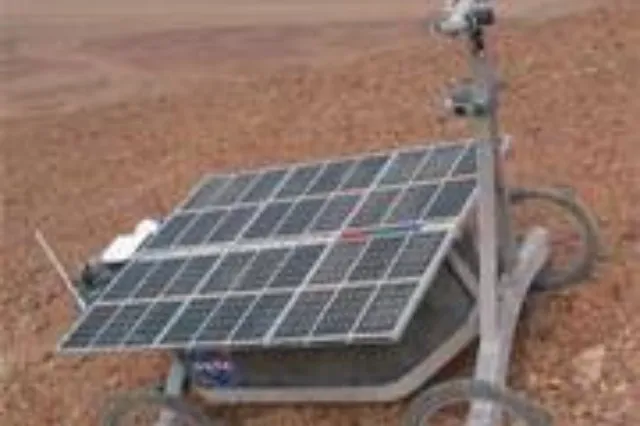
In 2004, David Wettergreen’s group at Carnegie Mellon University’s Field Robotics Center, working with researchers at NASA Ames Research Center and the University of Tennessee Department of Earth and Planetary Sciences, deployed a solar-powered rover called Zoe across the Atacama. Zoe was a four-wheeled platform carrying a drill for collecting subsurface samples and a fluorescence imager, a sensor that detects the chemical signatures of living cells by shining light on a sample and reading what bounces back. The combination let the rover find biological material below the surface rather than simply recording what the cameras could see.
What made the work different from earlier rover projects was how Zoe decided where to go. Rather than following a list of pre-planned waypoints set by operators back at base, Zoe used autonomous science-targeting algorithms to choose sample sites based on what its own sensors were telling it in the field. If the data suggested biological activity in one direction, the rover could adjust its path accordingly. The system planned its own traversals across the desert and acted on them.
The campaign showed that a robot could detect the distribution of micro-organisms across an extreme environment, and do it without someone watching every move. The Atacama site acted as a stand-in for Mars: the radiation levels, the dryness, and the subsurface biology all made it a reasonable analogue for the conditions a planetary rover would face. Carnegie Mellon’s Robotics Institute later documented the lessons from Zoe and its predecessor Nomad in a 2005 report, which described the field campaigns as running across several years from 2003 through 2005, with 2004 as the primary campaign season.
Why it mattered
Zoe demonstrated that a robotic rover could autonomously plan traversals, collect subsurface samples, and detect the distribution of micro-organisms in an extreme, Mars-analogue environment without continuous human guidance. This validated autonomous science-targeting methods, selecting sample sites based on onboard sensor data rather than pre-programmed waypoints, that inform the design of planetary rovers. The project's integration of drill sampling, fluorescence imaging, and autonomous navigation represented a concrete step toward robotic astrobiology missions.
People
David Wettergreen, Nathalie A. Cabrol
Organisations
Carnegie Mellon University Field Robotics Center, Ames Research Center, University of Tennessee Department of Earth and Planetary Sciences
Sources
- NASA Ames Research Center Press Release: Zoe Robot to Search for Life in Chile's Atacama Desert. NASA Ames Research Center. Official
- Nomad and Zoe: Lessons from Field Robotic Exploration. Carnegie Mellon University Robotics Institute. Secondary
Cite this page
AI Achievements. (2004). Zoe: Autonomous Astrobiology Field Robot for the Atacama Desert. Retrieved 2026-10-01, from https://achievements.ai/milestone/zoe-a-solar-powered-autonomous-robot
@misc{achievements_zoe_a_solar_powered_autonomous_robot,
  title  = {Zoe: Autonomous Astrobiology Field Robot for the Atacama Desert},
  author = {{AI Achievements}},
  year   = {2004},
  url    = {https://achievements.ai/milestone/zoe-a-solar-powered-autonomous-robot}
}