Rapid Object Detection Using a Boosted Cascade of Simple Features (Viola–Jones Face Detection)
Paul Viola and Michael Jones, then at Compaq CRL and Mitsubishi Electric Research Laboratories respectively, published a cascaded boosting framework for real-time face detection, first presented at CVPR in December 2001 and consolidated in the International Journal of Computer Vision in 2004. The method ran at frame rates suitable for live video on consumer hardware.
Background
Detecting faces in photographs had been a research problem since the 1970s, but by the late 1990s the best systems were still far too slow for practical use. A typical approach would train a neural network or support vector machine to decide whether a given patch of an image contained a face. That worked, to a degree. The problem was that you had to check thousands of overlapping windows across an image at multiple scales, and each check was expensive. On the hardware of the time, processing a single frame could take several seconds. Live video was out of the question.
The deeper difficulty was not just speed. Many earlier detectors also struggled with variation in lighting, pose and skin tone, producing too many false positives to be useful in real applications. Researchers had made incremental improvements through the 1990s, but no one had found a way to make both speed and accuracy move together in the right direction. The two goals seemed to trade off against each other by nature.
What happened
Paul Viola, then at Compaq Cambridge Research Laboratory, and Michael Jones at Mitsubishi Electric Research Laboratories presented their method at the IEEE Conference on Computer Vision and Pattern Recognition in December 2001. The full archival version appeared in the International Journal of Computer Vision in 2004.
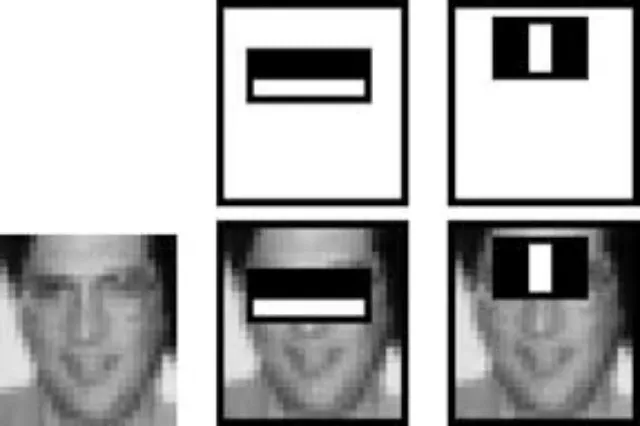
Their detector worked by scanning an image with a sliding window, asking at each position and scale: is there a face here? What made it fast was the combination of three ideas working together. First, they used Haar-like features, simple rectangular filters that measure differences in brightness between adjacent image regions. These are cheap to compute even in large numbers. They made them cheaper still with an integral image, a pre-computed lookup table that lets you sum pixel values over any rectangle in constant time, regardless of the rectangle’s size. Second, they trained an ensemble of these weak feature tests using AdaBoost, a boosting algorithm that combines many individually unreliable classifiers into a single reliable one by weighting each on where the previous ones went wrong. Third, and perhaps most consequentially, they arranged these classifiers into a cascade. Early stages in the cascade were very simple and could reject most image regions immediately, as the overwhelming majority of windows in any photograph do not contain a face. A window only passed to the next, more demanding stage if it survived the previous one. In practice, most windows were discarded within the first two or three tests.
The result was a detector that ran at fifteen frames per second on a 700 MHz Pentium III when trained to achieve a low false-positive rate on standard benchmarks, which was roughly fifteen times faster than comparable methods of the time at similar accuracy. Viola and Jones trained the detector on a large set of face images collected from the web and evaluated it against established test sets from the face detection literature. The cascade architecture meant the system spent almost no time on background regions and concentrated its effort where faces were plausible.
Why it mattered
The Viola–Jones detector was the first face-detection system to operate in real time on standard hardware without specialised accelerators, achieving detection speeds roughly fifteen times faster than prior methods at comparable accuracy. Its cascade of Haar-like features evaluated by AdaBoost classifiers became the dominant approach in commercial cameras, enabling automatic face-framing in consumer photography for the following decade. The framework also demonstrated that carefully engineered feature representations combined with ensemble learning could solve previously intractable computer-vision problems at practical speeds.
People
Paul Viola, Michael Jones
Organisations
Compaq Cambridge Research Laboratory, Mitsubishi Electric Research Laboratories
Sources
- Robust Real-Time Face Detection. International Journal of Computer Vision, Springer. Primary source
- Robust Real-Time Face Detection (MERL Technical Report TR2004-043). Mitsubishi Electric Research Laboratories. Official
- Rapid Object Detection Using a Boosted Cascade of Simple Features (CVPR 2001). IEEE Computer Society. Secondary
Cite this page
AI Achievements. (2004). Rapid Object Detection Using a Boosted Cascade of Simple Features (Viola–Jones Face Detection). Retrieved 2026-08-25, from https://achievements.ai/milestone/real-time-face-detection
@misc{achievements_real_time_face_detection,
  title  = {Rapid Object Detection Using a Boosted Cascade of Simple Features (Viola–Jones Face Detection)},
  author = {{AI Achievements}},
  year   = {2004},
  url    = {https://achievements.ai/milestone/real-time-face-detection}
}