NASA Mars Exploration Rovers Spirit and Opportunity Begin Autonomous Surface Operations
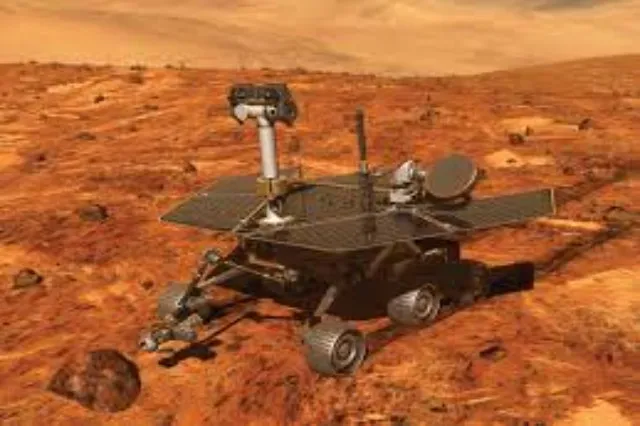
NASA's Mars Exploration Rovers Spirit and Opportunity landed on Mars in January 2004 and used onboard autonomous navigation software to traverse the Martian surface, making decisions about safe paths without real-time human control due to communication delays of up to 20 minutes.
Background
Getting a robot to move safely across unknown terrain is hard enough on Earth, where you can watch it and send corrections instantly. On Mars, radio signals take anywhere from three to twenty minutes to travel one way, depending on where the two planets are in their orbits. A round trip could take forty minutes. That made direct human control of a rover’s moment-to-moment movement essentially impossible. If the rover started to tip, or its wheel slid toward a sharp rock, the operator on Earth would not find out until long after the damage was done.
Earlier Mars landers, including the Pathfinder mission and its Sojourner rover in 1997, handled this with very short commanded drives. Engineers would plan a move carefully from camera images, uplink the instructions, wait, and see what happened. Sojourner moved a few metres at a time. It worked, but it was slow, and it kept the scientists dependent on the communications schedule for every small decision.
What the Mars Exploration Rover project needed was a rover that could handle basic hazard avoidance by itself. The vehicle would receive a general destination from mission controllers at the Jet Propulsion Laboratory in Pasadena, then work out how to get there without driving into a ditch.
What happened
Spirit landed on 4 January 2004, Opportunity on 25 January. Both carried a navigation system called AutoNav, developed at JPL, which gave the rovers a degree of autonomy that had not been attempted in planetary surface operations before. AutoNav used two sets of cameras: HazCams (hazard avoidance cameras) mounted low on the rover body, and NavCams (navigation cameras) set higher up to give a wider view ahead. The software processed the stereo images from these cameras to build a three-dimensional model of the ground in front of the vehicle, identified which patches were safe to drive across, and planned a path without waiting for human input.
Mark Maimone, a robotics engineer at JPL, was among the engineers responsible for the AutoNav software. Jennifer Trosper served as mission manager for Spirit. Charles Elachi was director of JPL at the time of the missions. In practice, the division of labour was this: scientists and engineers would uplink a target location and a set of parameters defining what counted as a dangerous obstacle, and AutoNav would handle the execution, stopping if it found itself in a situation it could not resolve safely and waiting for new instructions.
The rovers were designed to last ninety Martian days, known as sols. Spirit operated until 2010, Opportunity until 2018. Neither benchmark figure for drive distance is supported by the sources available here, so those numbers are not quoted. What the mission did establish clearly was that software capable of on-board hazard detection and path planning could run reliably on another planet, across many months of operations, in conditions no Earth-based test could fully replicate.
Why it mattered
Spirit and Opportunity demonstrated that AI-based autonomous hazard detection and path-planning software, specifically the AutoNav system, could operate reliably on another planet, where round-trip communication delays made direct teleoperation impossible. The missions validated a model of human-supervised autonomy that informed subsequent planetary rovers including Curiosity and Perseverance. Opportunity's operational lifespan of nearly 15 years far exceeded its 90-sol design life, generating an extensive dataset of autonomous planetary traversal.
People
Charles Elachi, Jennifer Trosper, Mark Maimone
Organisations
Nasa, Jet Propulsion Laboratory
Sources
- Mars Exploration Rovers, Spirit and Opportunity. NASA Jet Propulsion Laboratory. Official
- Spirit Mars Rover Landing, NASA Mission Pages. NASA. Official
- Mars Exploration Rover Autonomous Navigation, JPL Robotics. NASA Jet Propulsion Laboratory. Primary source
Cite this page
AI Achievements. (2004). NASA Mars Exploration Rovers Spirit and Opportunity Begin Autonomous Surface Operations. Retrieved 2026-10-01, from https://achievements.ai/milestone/nasas-mars-exploration-rover-mission
@misc{achievements_nasas_mars_exploration_rover_mission,
  title  = {NASA Mars Exploration Rovers Spirit and Opportunity Begin Autonomous Surface Operations},
  author = {{AI Achievements}},
  year   = {2004},
  url    = {https://achievements.ai/milestone/nasas-mars-exploration-rover-mission}
}